Industries


NEW: Asset Forfeiture Software
Build A More Consistent Forfeiture Program.
Consider a vehicle that has occupied the same space in an impound lot for three months.
Its physical location has not changed. During that time, however, the agency may have issued notices, received an ownership claim, or completed a valuation. Staff may also have conducted a legal review or placed the case on hold. The vehicle has remained still, but the asset forfeiture case has continued to change.
That is the central challenge of asset forfeiture tracking.
This disconnect creates significant risk for an agency. Staff may believe they have the matter under control because they know the vehicle is secure and where it is. When the vehicle has not moved, they may also assume the case has not either.
Staff need a clear view of the case’s procedural status and activity. Without it, they may overlook a required action or miss a deadline. They may also lose track of a pending claim or review. In some cases, they may move toward disposition before satisfying every requirement.
If someone later questions the case, the agency may be able to show where it held the vehicle. However, it may struggle to explain what happened, why staff made certain decisions, or who was responsible.
Effective asset forfeiture tracking requires agencies to connect three distinct types of information: location, status, and activity. A complete asset forfeiture management record brings these details together. Each type of information answers a different operational question.
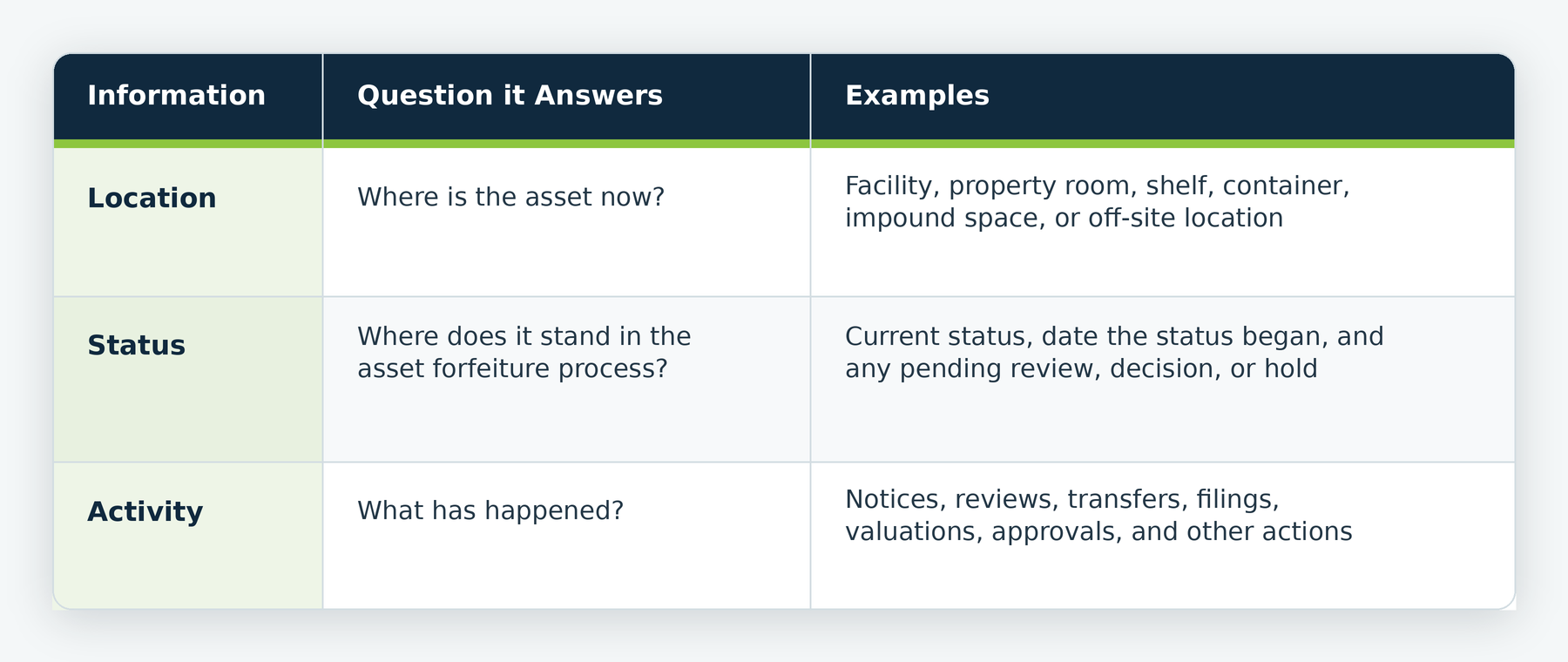
The asset record should identify the vehicle’s exact location, including the impound facility and parking space. It should also identify the person, department, or third party responsible for its custody.
Staff should update the record whenever they move, transfer, or temporarily release the vehicle. They should record the previous and new locations, the date and time, and who released and received it. The record should also explain why the vehicle moved and include any related authorization. Staff should document any changes to the vehicle’s condition or protective measures.
Effective seized asset tracking preserves each movement instead of replacing the previous location. For example, staff may release the vehicle for an appraisal and return it to the same parking space. Its current location may appear unchanged, but the record must still show who possessed it, why it left the facility, and when it returned.
When seized property is also evidence, this documented history helps maintain a clear chain-of-custody record.
Location history explains where an asset has been and who has handled it. But it does not reveal where the vehicle stands in the asset forfeiture process.
Location describes where the property is held. Status describes where it stands in the forfeiture process.
Even when the vehicle remains in the same impound space, its status may change. The case may move from initial review to notice issued or claim received. Staff may later mark the case as contested, awaiting a decision, on hold, or ready for final disposition.
Law enforcement agencies should define statuses that reflect their policies, workflows, and jurisdictional requirements. Each status should have a consistent meaning across departments.
The asset record should show the current status, when it began, and what prompted the change. It should also identify any pending review, decision, or action. If the asset or case is on hold, the record should explain why.
Consistent statuses help staff identify cases that are progressing, delayed, or ready for disposition. They also show which cases are awaiting external action. Supervisors can then find cases that have remained in one status for too long without requesting updates individually.
The current status may show that the case awaits a court decision. However, it does not explain how the case reached that point.
Complete asset forfeiture records need a chronological activity history. This history preserves every action related to the asset and its forfeiture case. These actions may include notices, claims, reviews, valuations, filings, and approvals.
Each entry should document what happened, when it happened, who completed or recorded the action, and why. It should also link to supporting documents or authorizations. Finally, the entry should show whether the action changed the asset’s status, location, or custody.
For example, staff may mail a notice and confirm delivery. A claimant may then file an ownership claim, which staff send for legal review. The agency may complete an appraisal and place the case on hold while awaiting a court decision.
Together, those events explain why the vehicle remains in the impound lot and why the forfeiture case remains unresolved. Without that history, staff may have to search emails, spreadsheets, documents, and departmental records to reconstruct what happened.
Asset forfeiture case management often crosses property and evidence, investigative, legal, financial, and administrative teams. When agencies connect location, status, and activity, every department can see the same information. Teams can see where the asset is, where the case stands, what has occurred, and what must happen next.
Departments may manage different parts of the process. However, the agency remains responsible for maintaining one consistent and explainable record. That record should follow the asset from its initial seizure through legal review, financial activity, and final disposition.
For every seized asset, the agency should be able to answer:
Where is the asset now, who has custody, and where has it been?
Where does it stand in the forfeiture process, and how long has it held that status?
What actions and decisions brought it to this point, and where is the supporting documentation?
Is the asset or case on hold?
What must happen next, and who is responsible?
Staff should not need to search multiple systems, spreadsheets, and paper files to answer these questions. They should not have to contact several departments for basic updates. If they do, the agency may lack a complete view of its asset forfeiture process.
Three months later, the seized vehicle may still occupy the same space in the impound lot. An inventory can confirm that it is there. A complete asset forfeiture record should explain what has happened and where the case stands. It should also identify the next step and the person responsible for it.
Effective asset forfeiture tracking helps law enforcement agencies do more than locate an asset. It helps them maintain control of the entire forfeiture process.